
Do Spa Hotels Actually Help You Sleep Better?

Founder & Editor, Spa Hotel Finder
Experience
20+ years in media and travel publishing
The Telegraph · Condé Nast International · Time Out Group
Education
Executive MBA · ESCP Business School
Expertise
Spa Hotels · Spa Pricing and Resort Fees · Wellness Travel · Hot Springs and Bathing Traditions
Published · Updated · 9 min read
A spa hotel can genuinely improve your sleep when it controls for noise, light, temperature, and a decent mattress. The real question to ask is whether you need a clinical program for a diagnosed disorder or a well-run environment for environmentally-driven bad sleep.
In 30 Seconds
- Ask exactly how blackout is built: full-length curtains that overlap and a sealed door gap, not a vague promise.
- Keeping the room at 15 to 19°C adds over 20 minutes of sleep, and most hotels never tell you what to set.
- Suits anyone whose bad sleep is environmental; skip it if you have diagnosed insomnia, apnoea, or circadian disruption.
What our reviews across 100+ properties reveal about the gap between sleep marketing and sleep reality.
Hotels have been claiming to offer exceptional sleep for as long as there have been thread-count numbers to print on the packaging. Now the industry has a name for it — sleep tourism — and a market valuation to match. The global sleep tourism sector was worth $74.5 billion in 2024 and is growing at an annual rate of 8%. Hilton has declared 2025 the year of ‘Sleep Tourism 2.0’. Six Senses employs a Sleep Doctor. Canyon Ranch runs overnight sleep studies in on-site medical rooms.
The question worth asking, then, is whether any of this actually works.
After reviewing more than 100 spa hotels across Europe, the US, and Asia for the SpaRator, we have some answers. They’re not as simple as the marketing suggests.
Why You Probably Sleep Worse in Hotels Than You Think
Start with an inconvenient truth: most hotels are genuinely bad for sleep. A large-scale study of hotel guests identified the primary culprits: poor mattresses, high room temperatures, street noise, ventilation system noise, and light seeping through inadequate curtains. These are not fringe complaints from difficult guests. There are structural problems baked into how most hotels are designed and operated.
Noise is the most insidious offender. The World Health Organization’s Night Noise Guidelines suggest that sleep disturbance begins at 30-40 dB — roughly the level of a quiet conversation. Hotel corridors, lifts, thin party walls, and HVAC ducts routinely breach this threshold. Urban properties are fighting an even harder battle: traffic noise and emergency services operate well above 55 dB, at which point adverse health effects become widespread.
Light is the second structural failure. Your body produces melatonin in response to darkness; artificial light suppresses it. The problem in most hotel rooms is not just the curtains — it’s the LED standby light on the television, the green glow of the fire alarm panel, the illuminated thermostat display. In rooms with genuine blackout provisions, these small sources of light still seep under doors and around curtain edges. Researchers have described guests who travel with black duct tape specifically to seal light leaks. This is not eccentric. It’s a rational response to rooms that fail a basic test.
Temperature is the third factor, and the one most easily fixed. Sleep science is clear: the optimal temperature for sleep sits between 15°C and 19°C (60-67°F). Core body temperature naturally drops in the two hours before sleep; a room that’s too warm disrupts this process and fragments sleep architecture. One study found that manipulating nighttime room temperature alone could deliver more than 20 additional minutes of sleep per night.
The same mechanism runs the other direction, too: a hot soak or sauna session in the early evening triggers a stronger rebound drop in core temperature by bedtime, which is part of why bathing cultures pair heat with rest. Our guide to communal bathing covers those traditions and what the research actually supports.
The optimal sleep temperature is 15–19°C. One study found that controlling it alone adds 20+ minutes of sleep per night. Most hotels have never told guests how to set the thermostat.
The reason spa hotels matter in this context is that they’re the segment most likely to have given serious thought to all three. But the gap between serious thought and execution varies enormously.
What Our Reviews Actually Reveal
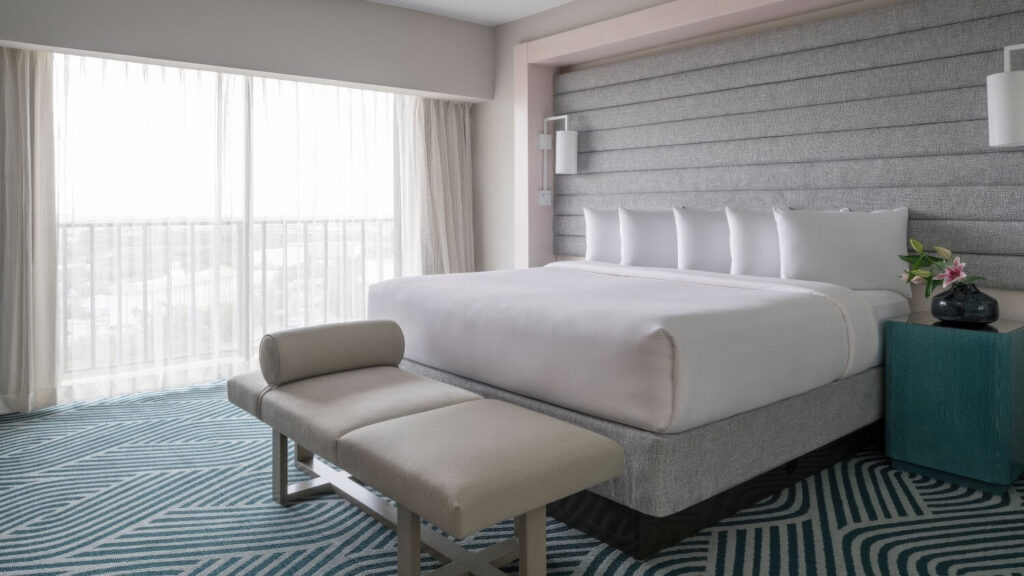
Across our property assessments, we score sleep environment as a composite: blackout effectiveness, acoustic insulation, mattress and bedding quality, temperature control, and any sleep-specific programming. Here’s what the data shows.
Blackout: the most variable factor
Full blackout — the kind where you genuinely cannot see your hand six inches from your face — is rarer than it should be at properties charging $300+ a night. We’ve found it reliably at rural and forest-set properties (where external light pollution is low and operators invest in lined curtains with proper overlaps) and inconsistently at urban spa hotels where architectural glazing prioritizes views over darkness. Six Senses properties score highest on this metric across our dataset — blackout provisions are built into their design standard rather than retrofitted.
Several UK country-house spa hotels we’ve reviewed lose points specifically because their period sash windows and listed status prevent the installation of full blackout blinds.
The specific failure mode to look for: curtains that don’t overlap at the center, light gaps around door frames (particularly relevant if your room faces an illuminated corridor), and any in-room technology that displays ambient light. The best properties address all three. Most address none.
Acoustics: rural vs urban is not the whole story
Location matters, but it’s not determinative. We’ve reviewed countryside spa hotels with thin internal walls that transmit every sound from adjacent rooms, and we’ve reviewed urban properties — the Equinox Hotel New York being the standout — where room construction effectively eliminates external noise. Premier Inn’s ‘floating bedroom’ design in Leicester Square, which physically decouples room structure from the building frame, demonstrates that genuine acoustic engineering is achievable even in central London. Most spa hotels haven’t made this investment.
What we look for: whether rooms share walls with public corridors or lift shafts (poor), whether HVAC systems produce consistent white noise (helpful, but only if the frequency doesn’t spike) or intermittent mechanical sounds (very disruptive), and whether pool or treatment areas generate noise that carries to guest rooms at night. The last point eliminates several otherwise well-regarded properties from sleep-focused recommendations — spa infrastructure that operates until 22:00 creates exactly the low-frequency rumble that research identifies as most disruptive to light sleep stages.
Mattresses: the biggest spend gap
This is where luxury pricing delivers most consistently. In our reviews, the correlation between nightly rate and mattress quality is clearer than the correlation between nightly rate and blackout provisions or acoustics — both of which require architectural commitment rather than simply spending.
Properties at the $400+ per night bracket almost universally offer mattresses we’d rate as genuinely exceptional: Hypnos or Vi-Spring for UK properties, Hastens for Scandinavian ones, custom organic-wool mattresses at Six Senses (handmade from certified-organic lamb’s wool with a natural latex layer from the world’s only certified organic rubber plantation).
The caveat: mattress quality degrades over time, and replacement cycles vary. A property that invested in exceptional beds five years ago may now have mattresses that have compressed and lost support at their edges and centers. This is particularly true of boutique spa hotels without the operational scale of branded groups. We note mattress age and condition in our physical assessments where possible.
Temperature control: widely mishandled
Individual room temperature control is standard at this tier. The problem is that most hotels don’t tell guests what temperature they should set, and default thermostat positions tend toward warmth — comfortable at check-in, disruptive for sleep. In our reviews, we note whether properties provide any guidance on sleep-optimized room temperature. The majority don’t. Six Senses is the exception: their sleep standard explicitly includes guidance on room temperature as part of the Sleep Ambassador briefing.
Properties with air conditioning that cycles on and off noisily throughout the night — rather than maintaining a consistent, near-silent output — represent a specific failure mode. We’ve found this more frequently in warm-climate spa destinations, where properties rely on older HVAC systems with obvious on/off cycling. It’s the kind of problem that doesn’t show up in room photos and is hard to assess from reviews.
Sleep Programming: Who’s Actually Doing It Well
Sleep-specific programming divides into two distinct categories, and it’s worth being clear about which you’re looking for.
The first category is clinical: properties where sleep issues are diagnosed and treated. Canyon Ranch in Tucson runs overnight polysomnography studies — full sleep labs with medical-grade monitoring — reviewed the following morning with their Director of Sleep Medicine. SHA Wellness Clinic in Andalucia employs an in-house sleep medicine specialist, Dr. Vicente Mera, who creates personalized treatment plans combining modern diagnostics with traditional Chinese medicine. Sensei at Lānai and Porcupine Creek mails guests a WHOOP 4.0 wearable before arrival to collect baseline data, then uses it to design a customized five-night program. These are genuine clinical interventions. They’re appropriate if you have an identified sleep disorder or want data-backed optimization.
The second category is facilitation: properties that create the conditions for good sleep, including programming to help guests wind down effectively. This is what most spa hotels offering ‘sleep packages’ actually deliver, and it’s not a lesser thing — it’s simply different. An evening hydrotherapy circuit that drops core body temperature, a yin yoga session at 19:00, a magnesium-rich dinner, and a room that’s genuinely dark and quiet by 21:00 will do more for most guests’ sleep than a biometric tracker.
Six Senses sits somewhere between the two: their Sleep Doctor-designed program includes a pre-arrival questionnaire, a dedicated Sleep Ambassador, sleep tracking throughout the stay, and a customized treatment schedule, but stops short of clinical diagnostics. It’s the most comprehensive facilitation program we’ve encountered across the properties we’ve assessed.
A magnesium-rich dinner, an evening hydrotherapy circuit, and a genuinely dark room will do more for most guests’ sleep than a WHOOP tracker. Know which category of help you’re actually looking for.
Who Actually Benefits (and Who Probably Won’t)
The strongest candidates are those whose sleep problems are environmental rather than chronic. If you sleep badly at home because of a partner, noise, light, an inadequate mattress, or the cumulative stimulation of a demanding life, a well-chosen spa hotel addresses all of these directly.
The research is on your side: Hilton’s 2024 survey found two-thirds of Americans sleep better in hotels than at home, and this effect is most pronounced when the hotel actively manages noise, light, and bedding quality rather than relying on a change of scene alone.
The weakest candidates are those with clinical sleep disorders: insomnia disorder, sleep apnoea, and circadian rhythm disruption from shift work or jet lag. For these guests, a spa setting provides comfort but not treatment. The first-night effect — in which one hemisphere of the brain remains partially vigilant in unfamiliar surroundings — also hits this group hardest, and can mean that a two-night stay produces only one genuinely good night’s sleep (the second), after adaptation has occurred. If this is your situation, Canyon Ranch or SHA Wellness are the appropriate properties. A countryside spa with a nice mattress and a sound bath at 18:00 is not.
There’s also a meaningful difference between guests whose sleep goal is restoration (arriving tired, leaving rested) and those whose goal is improvement (taking home better sleep habits). The former suits almost any well-run spa hotel. The latter requires programming with a take-home component — a structured wind-down routine, dietary guidance, CBT-I techniques, something behavioral to sustain the benefit. Without this, the improved sleep is a feature of the stay, not a lasting change.
Where to try it
Hotels in This Guide
 SpaRator 7.5: Strong
What to Actually Look For When Booking
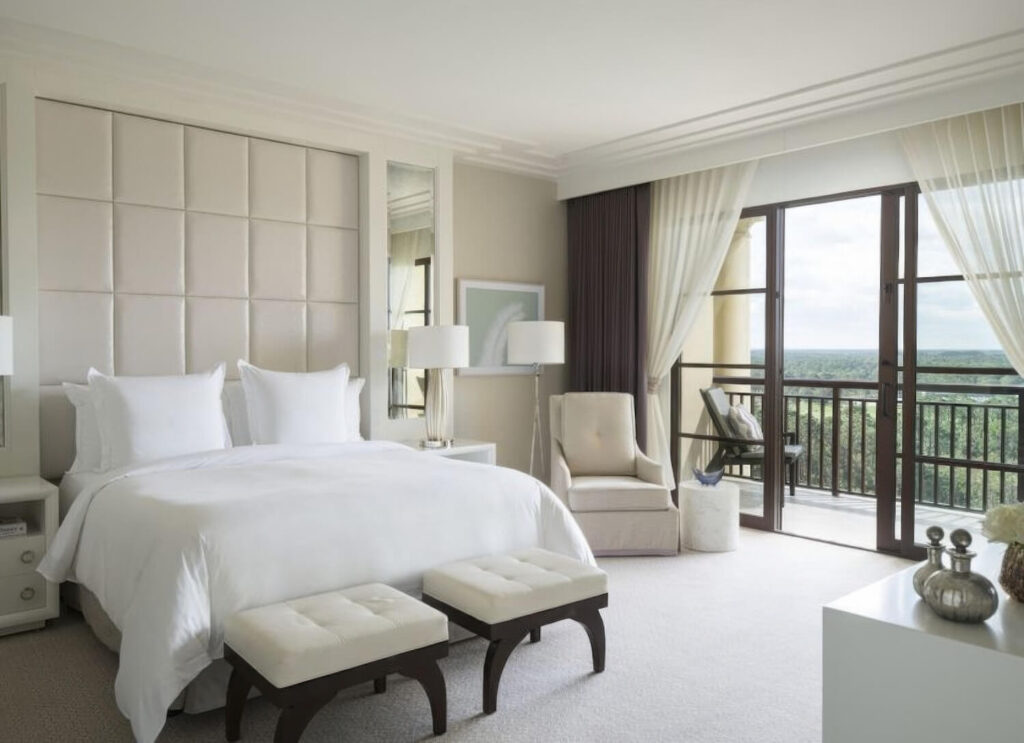
Four questions we’d recommend asking before booking any hotel on sleep grounds:
First: What are the blackout provisions? If the hotel can’t answer specifically (‘lined, floor-to-ceiling curtains with full overlap, light-sealed door gap’) treat the answer as inadequate. ‘Good blackout curtains’ is a marketing phrase, not a specification.
Second: are the rooms internally quiet, and what shares the wall? A spa hotel with a pool that runs until 22:00 is not a sleep hotel in any meaningful sense. Ask whether your room faces the car park, the road, the spa, or the garden — and request the garden.
Third: what temperature control does the room have, and is there guidance on sleep-optimized settings? This one question reveals whether a property has thought seriously about sleep or simply invested in a new mattress and called it a sleep package.
Fourth: What does the programming actually include, and what’s the take-home element? If the answer is a sleep-themed massage and some lavender pillow spray, that’s a lovely spa treatment, not a sleep program. Fine if that’s what you want. Not fine if the booking implied something more substantive.